Embracing Education's AI-Driven Revolution
- The Imperial, New Delhi
- Saturday/Sunday, June 18-19, 2022
About the Program
Fourth Revolution in Education – Prepare or Despair
A ‘Fourth Revolution’ is already underway across the world, and it promises to be a spectacular reimagining of traditional education systems. This need for reimagining was caused the devastating COVID-19 pandemic that disrupted the rapid globalising of the economies of the world, spurred by advancements in transportation and communication.
However, the advancements – heavily influenced by Artificial Intelligence and its offshoots – have also raised ethical questions, raising existential dilemmas over liberal values. The discussions at this conference over two days on June 18-19, 2022, in New Delhi, India will involve internationally-reputed personalities, institutions, and decision-makers, physically present or in virtual mode.
It will focus on an Artificial Intelligence (AI)-driven cyberspace, coupled with the devastating impact of the pandemic that has impacted globalisation and accelerated the overhauling long-cherished education systems.The pandemic’s impact, that curtailed easy travel and trade – cornerstones of globalisation – has accelerated the processes of the Fourth Revolution in overhauling long-cherished education systems.
This transformation offers learners from varied strata of society breath-taking access to personalised tuition and digital educational material. The pandemic, it must be acknowledged, forced international educational institutions and systems to accept – long before they were ready – online platforms to impart teaching and learning from the sanctuary of their own homes. It caused a rethinking of the Third Education Revolution, which promoted mass teaching methods and took the shape of continuous learning. The first two education revolutions had previously brought major changes to the structure of educational institutions and teaching, as well as learning approaches.
The transformations were also conditioned by major changes in economic and other geopolitical shifts. Often, there was a direct link in expansion of the education systems and their inclusivity to the needs of labour – in the prevailing economic conditions. This will cause the disruption of jobs. Even as vast sections of predominantly ageing populations in the great economies turn to assistance from cyberspace and its byproducts in robotics, powered by AI, the fear is growing of great job losses and resultant, crushing poverty in the developing world.
There is, however, a gentler vision that envisages a future where people and machines coexist; and indeed work toward the benefit of humanity from effective partnerships. It is indeed imaginable, that new kinds of jobs will emerge for humans that may not be conceivable today. It is, however, equally evident that this revolution needs to be shaped to promote humanistic societal values.
This conference aims to stimulate the imagination to seek ways to become an agent and not the captive of civilisational changes that shape future generations.
PROGRAMME
DAY ONE
INAUGURAL SESSION
1000 hrs to 1100 hrs
Welcome Address: Mr. Moses Manoharan, Chair, Global Dialogue Forum
Special Address: India’s World Class Potential in Education: Mr. S. Ramadorai, Chair, Club of Rome – India, former Adviser to the Prime Minister in the National Council on Skill Development
Keynote Address: Hon’ble former Minister of State for Electronics and Information Technology, Mr. K.J. Alphons, Member of Parliament
Note of Thanks: Ms. Nisha Ramdas, Managing Editor, Global Dialogue Review
SESSION I
1115 hrs to 1245 hrs
Shaping the World Order through Education
Chair – Mr. Salman Khurshid, former External Affairs Minister of India, Senior Advocate of Supreme Court of India, former Law Minister of India, prominent educationist, taught law at Oxford University, UK
Speaker – Lt. General Sunil Srivastava, AVSM, VSM** (Retd), Director, Centre for Joint for Warfare Studies (CENJOWS)
Speaker – Mr. Shreyas Jayasimha, founder, Aarna Law (India) and practiced in domestic and international dispute resolution, a range of issues including space law, technology and nuclear law
Speaker – Tan Sri Dato Professor Joseph Adaikalam, Executive Chairman, Binary University, Selangor, Malaysia. It is a specialist university for Management, IT and Entrepreneurship
======================
LUNCH – 1245 hrs to 1345 hrs
======================
SESSION II
1400 hrs to 1530 hrs
Education’s Fourth Revolution and Artificial Intelligence
Chair – Dr. Ranjan Bose, Director, Indraprastha Institute of Information Technology, New Delhi
Speaker – Mr. Abhimanyu Raja, Managing Director, Janyu Technologies, Mumbai.
Speaker – Brigadier R. Putarjunam, Additional Director General, Army Educational Corps
Speaker – Mr. Mathew Johnston, Australian Government Department of Education, Skills and Employment
Speaker – Dr. Rajeev Tyagi, Principal, Mount Carmel School, Dwarka, New Delhi
====================
TEA – 1530 hrs to 1600 hrs
====================
SESSION III
1615 hrs to 1745 hrs
AI-Driven Education and Sustainable Development Goals
Chair – Lt. General Arun Sahni, UYSM, SM, VSM (Retd), Director General, Club of Rome – India, former GOC, South Western Command, Distinguished Fellow, Global Dialogue Forum
Speaker – Dr. Ashok Khosla, Chair, Development Alternatives, Trustee, Club of Rome – India
Speaker – Dr. Ameeta Wattal, Chair and Executive Director, Education, Innovations and Training, DLF Foundation
Speaker – Mr. Pranav Gupta, Managing Director, Print Publishing, Frontlist
Speaker – Mr. Pierrick Fillon-Ashida, First Counsellor, Head of Research and Innovation Sector, Delegation of the European Union to India
DAY I CONCLUDES
DAY II
SESSION IV
0930 hrs to 1145 hrs
Ensuring Gender Equity through Education
Chair – Professor Kavita Sharma, former President, South Asian University of the South Asian Association for Regional Cooperation (SAARC)
Speaker: Ms. Charu Modi, Chancellor, K.K. Modi University, a scion of a leading Indian industrialist family, she is an eminent educator. She is Executive Director, Indofil Industries Limited, Promoter and Shareholder, K.K. Modi Group, and Vice Chair and CEO, Modi Academic International Institute
Speaker – Dr. Lailufar Yasmin, Professor, Department of International Relations, University of Dhaka, Bangladesh
Speaker – Dr. Babli Moitra Saraf, Principal, Indraprastha College for Women, University of Delhi
======================
LUNCH – 1200 hrs to 1300 hrs
======================
VALEDICTORY ADDRESS
1315 hrs to 1445 hrs
Education’s Fourth Revolution – Maintaining Standards to prepare India for a Global Role by Professor Anil Sahasrabudhe, Chair, All India Council on Technical Education
=====================
HIGH TEA
====================
Our Keynote Speakers
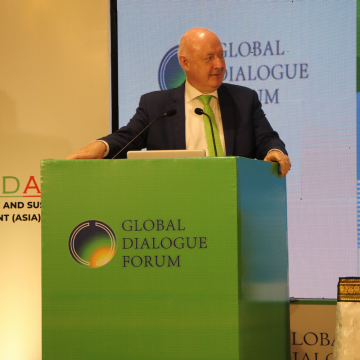
Mr. S. Ramadorai, Chair
Club of Rome - India, former Adviser to the Prime Minister in the National Council on Skill Development
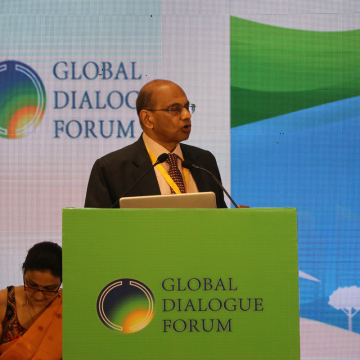
Mr. K.J. Alphons
Hon’ble former Minister of State for Electronics and Information Technology, Member of Parliament