Managing Cyberspace in the Indo Pacific – The Global Dialogue Security Summit
- Shillong, Meghalaya
- Wednesday/Thursday, November 24/25, 2021
About the Program
A future world dominated by cyberspace is being shaped before our eyes. It has already influenced and redefined many vital concerns of humankind — from defence and security to the environment to health to social life.
Its algorithms will in time accurately predict what is to come; based on data from the past and present, to hopefully enhance the quality of life.
It is indeed a ‘Fifth Frontier’ — laying down the contours and content of a world order that was previously determined by dominance of land, water, air and space. Analysing this ‘Fifth Frontier’ — with its threats and opportunities — will form the substance of this conference.
On this frontier will wars be fought and peace won, using technological advancements to build equitable economic prosperity and environmental sustainability.
In fact, the potential for good and evil is a challenge and opportunity confronting humanity, as its leaders and influencers come to terms with cyberspace.
The distancing of human, physical engagement in war-fighting and in penetrating personal privacies will probably deepen the divide between the developed and developing world, even as they raise grave concerns over widely cherished principles of privacy.
That these advancements over cyberspace will emphatically impact and alter human behaviour seems certain. It could also result in a new and frightening Cold War, spearheaded by both old and new antagonists.
The Cyber conflicts — already raging in low intensity — have the potential to flare into horrific wars that cause suffering on a far greater scale than conventional weapons when critical infrastructure is penetrated.
The threat of nuclear war may even be overshadowed by potential attacks on critical national infrastructure, from energy to telecom to health, with equally, if not greater devastating consequences.
Cyber-defensive and cyber-offensive abilities will come to define the great military powers.
Cyberspace’s accessibility has indeed opened the floodgates to the involvement of state and non-state actors, including corporates and individuals.
Both hacktivist and terrorist will find voice in this space.
This has thrown up dilemmas that include bridging the gulf between cyberspace’s open and secure forms, traditional notions of sovereignty in evolving global rules of engagement, digital democracy and diplomacy, protecting data, enforcing legal protocols and upholding ethical values.
Amidst the globalisation of information, cyberspace itself faces several technological challenges, ranging from innovations in theory and in application.
This conference will discuss the possible transition from the traditional to a new global cyberspace, whose characteristics are openness, heterogeneity, mobility, dynamism, and security.
The realisation is dawning that of cyberspace security is a high priority.
Compared with traditional network security, future cyberspace security will have to consider the obsolescence of traditional static methods based on known threat characteristics in order to effectively defend against novel forms.
Programme
INAUGURAL SESSION: 1000 hrs to 1100 hrs
Introductory Remarks: Mr. Moses Manoharan, Chairman, Global Dialogue Forum
An Indian Perspective: Ambassador Ruchi Ghanashyam, IFS (Retd), India’s former High Commissioner to the UK, Chairperson Conference Organising Committee
The European Perspective: Mr. Peter Rimmele, Resident Representative to India, Konrad Adenauer Stiftung
Keynote Address: Lt. General (Dr) Rajesh Pant, PVSM AVSM VSM (Retd), National Cyber Security Coordinator
Presenter: Ms Abha Mylliemngap
Coffee Break – 1100 hrs 1130 hrs
SESSION I – 1145 hrs to 1315 hrs
Defining Cyberspace and Identifying its Challenges
Chair: Major General (Retd.) Lav Bikram Chand, Corps of Signals, Indian Armed Forces
Speaker: Vice Admiral (Dr.) Ir. Amarulla Octavian, S.T., M.Sc., DESD, of the Indonesian Navy, Rector of the Republic of Indonesia Defense University (Virtual)
Speaker: Mr. Md. Nobir Uddin, senior System Analyst, ICT Division, Ministry of Posts, Telecommunications and Information Tevhnology, Government of Bangladesh, Dhaka
Speaker: Brigadier Ashish Chhibbar, alumnus of Military College of Telecommunication Engineering and Indian Institute of Science, specialist in Artificial Intelligence.
LUNCH – 1330 hrs to 1430 hrs
SESSION II-1445 hrs to 1630 hrs
Collaboration and Conflict over Cyberspace in the Indo Pacific
Chair: Lt. General Arun Sahni, UYSM, SM, VSM (Retd), former General Officer Commanding, South Western Command, involved in armed forces cyber, digitisation and network enablement.
Speaker: Mr. Amit Sharma, Cyber Advisor, Defence Research and Development Organisation (DRDO) / Office of Secretary, Department of Defence (R&D), Ministry of Defence of India
Speaker: Dr. Geoff Herriot, Member of the Council (management committee), Tasmania branch, Australian Institute of International Affairs (AIIA), one of Australia’s oldest think tanks (virtual)
Speaker: Mr. Alok Sinha, Chief Executive Officer, Globus Eight Inc, Gurgaon, India (virtual)
High Tea 1645 hrs – 1700 hrs
SESSION III – 1715 hrs to 1830 hrs
Cyberspace in Industrial Development
Chair: Ambassador A.R. Ghanashyam IFS (Retd), India’s former envoy to Nigeria, alumnus of Indian Institute of Management, Ahmedabad
Speaker: Professor Heribert Dieter, Economist, Stiftung Wissenschaft und Politik, German Institute for Security and International Affairs, Berlin, Germany
Speaker: Mr. Ravi Nirgudkar, Managing Director, BAE Systems – India
Speaker: Mr. Argha Bose, Head, Cyber Security, Tata’s Advanced Systems Limited
DINNER RECEPTION 1930 hrs to 2200 hrs
DAY II
SESSION IV – 1000 hrs to 1130 hrs
Conventional War, Cyberspace and Sovereignty
Chair: Lt. General Sunil Srivastava, AVSM, VSM** (Retd), Director, Centre for Joint Warfare Studies (CENJOWS)
Speaker: Mr. K.P.M. Das, National Cyber Security Officer, Cisco (Virtual)
Speaker: Mr. George Mikaberidze, Chief Executive Officer, Rosinfokominvest, Moscow, Russia (virtual)
Speaker: Mr. Shreyas Jayasimha, specialist in cyber and space laws, Founding partner, Aarna Law LLP, Bangalore
SESSION V- 1145 hrs to 1315 hrs
Cyberspace Connectivity for Peace and Development in India’s Northeast
With a special address by: Hon’ble Chief Minister of Meghalaya, Mr. Conrad Sangma
Chair: Mr. K.J. Alphons, Member of Parliament, Member, Parliamentary Standing Committee on External affairs, is a former senior Indian civil servant and advocate. He has been India’s former Minister of State for Culture, Tourism and Minister of State for the Ministry of Electronics and Information Technology
Speaker: Dr. Pfokrelo Kapesa, assistant Professor, International Relations, Northeast Christian University (NECU), Dimapur, Nagaland
Speaker: Dr. Tabassum Jamal, former Chief Scientist, National Institute of Science Technology and development Studies (NISTADS) at the Council of Scientific and Industrial Research (CSIR), Government of India, New Delhi (virtual)
Speaker: Mr. Mutchu Mithi, Hon’ble Member of the Legislative Assembly, Roing, Arunachal Pradesh
LUNCH 1315 hrs to 1415 hrs
SESSION VI 1430 hrs to 1600 hrs
Cyberspace Warfare and Neighbourhood Threats
Chair: Ambassador Ruchi Ghanashyam IFS (Retd), former Indian High Commissioner to UK
Speaker: Lt. Col. Ofer Rotberg (Retd) Head of Cyber-Security, Elbit Systems, where he leads the CyberShield programme protecting weapons systems, C2 networks and the future battlefield (virtual)
Speaker: Dr. Adam Svendsen, an intelligence and defence strategist, is associate consultant at the Copenhagen Institute for Futures Studies, Denmark (virtual)
Speaker: Dr. Gudrun Wacker, Chinese foreign and security policy expert at the German Institute for International and Security Affairs, Berlin, Germany
VALEDICTORY ADDRESS- 1615 hrs to 1745 hrs
Cyberspace Wars – Protecting and Defending India
Speaker : Mr. Naveen Kumar Singh, IPS, Director General National Critical Information Infrastructure Protection Centre (NCIIPC). The NCIIPC is the nodal agency protecting India’s information infrastructure from threats ranging from cyber terrorism to cyber warfare
Summing Up: Mr. Pankaj Madan, Deputy Head, Konrad Adenauer Stiftung – India
Vote of Thanks: Nisha Ramdas, Conference Director, Director, Global Dialogue Forum
DINNER RECEPTION 1900 hrs onwards
Our Keynote Speakers
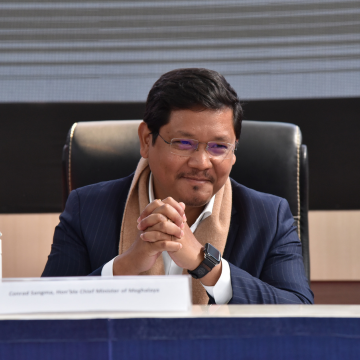
Mr. Conrad Sangma
Hon'ble Chief Minister of Meghalaya
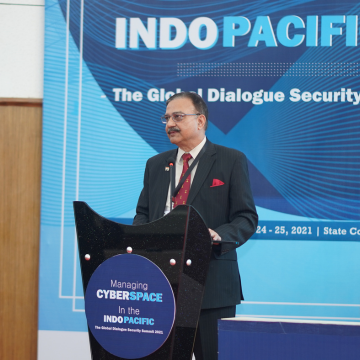
Lt. General (Dr) Rajesh Pant
PVSM AVSM VSM (Retd), National Cyber Security Coordinator
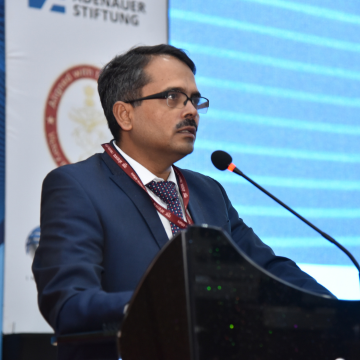
Mr. Naveen Kumar Singh
IPS, Director General National Critical Information Infrastructure Protection Centre (NCIIPC)
Our Knowledge Partners